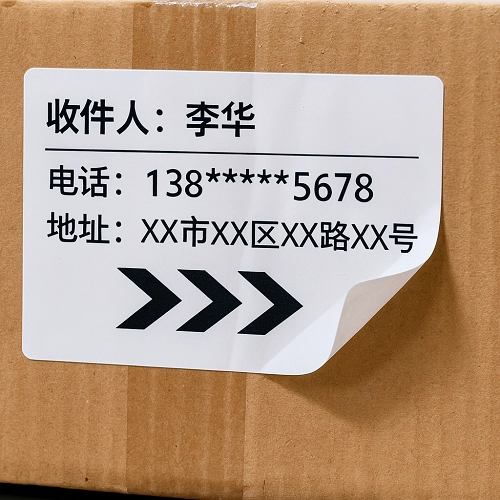
If you have ever scanned a barcode at a checkout counter, tracked a parcel through a logistics hub, or read a dosage label on a medicine bottle, you have almost certainly interacted with a general-purpose thermal adhesive. It is one of the most widely produced — and most frequently misunderstood — materials in the labeling industry.
A general-purpose thermal adhesive is a composite label material that combines two functional layers on a single paper or film substrate: a heat-sensitive thermal coating on the print side, and a pressure-sensitive adhesive (PSA) on the reverse side, protected by a silicone-coated release liner. The word "general-purpose" signals that the adhesive formulation is engineered for broad substrate compatibility and moderate environmental exposure — as opposed to specialty grades built for freezer storage, extreme chemical exposure, or removable/repositionable use.
Because it prints without ink, toner, or ribbon, this material is often called "direct thermal adhesive paper." The image is produced entirely by a chemical reaction inside the coating itself, triggered by the thermal print head.
The thermal-reactive layer is built from three core chemical components suspended in a binder:
When the thermal print head heats a specific pixel to roughly 70–110°C, the sensitizer melts, allowing the leuco dye and developer to merge and form a stable black (or colored) mark. This is why direct thermal printing requires no consumables beyond the label stock itself — a major cost and maintenance advantage in high-volume printing environments.
On the reverse face, the pressure-sensitive adhesive — usually an acrylic emulsion — is engineered to bond on contact, without heat, solvent activation, or curing time. Formulation variables such as tack, peel strength, and shear resistance are tuned to balance immediate grab against long-term holding power across substrates including cardboard, glass, coated cartons, and metal.
Fig. 1 — Simplified layer structure of a general-purpose thermal adhesive label (original diagram).
Below is a representative specification set for a general-purpose grade, based on the coating and converting parameters used in Guanhao's Thermal Adhesive product line.
| Base Material | Thermal-sensitive paper with pressure-sensitive adhesive backing |
| Basis Weight | 60–80 gsm (application-dependent) |
| Adhesive Type | General-purpose permanent acrylic pressure-sensitive adhesive |
| Liner / Release Material | Silicone-coated glassine or kraft paper |
| Print Sensitivity | High — consistent density across a wide print-speed range |
| Application Temperature | 10 °C – 40 °C |
| Service Temperature Range | −20 °C – 70 °C |
| Roll Widths | 40 mm – 110 mm; custom widths available |
| Printer Compatibility | Zebra, Honeywell, SATO, Epson, Brother, and most direct thermal printers |
| Recommended Shelf Life | 12 months from production date under correct storage |
Not every application needs maximum chemical resistance, and paying for it unnecessarily raises per-label cost. The table below compares the three most common thermal adhesive tiers so you can match the grade to the environment.
| Grade | Water / Oil / Alcohol Resistance | Typical Use Case | Relative Cost |
|---|---|---|---|
| Ordinary Thermal Paper Adhesive | Minimal | Dry retail receipts, short-shelf-life indoor labels | $ |
| General-Purpose Thermal Adhesive | Moderate | Shipping labels, warehouse and inventory tags, general retail | $$ |
| Economic Three-Proof Thermal Adhesive | Good, cost-optimized | Logistics, food packaging, mid-tier chemical exposure | $$$ |
| High-Quality Three-Proof Thermal Adhesive | Excellent, fluorescent-free | Pharmaceutical, medical, food-grade, regulated environments | $$$$ |
General-purpose thermal adhesive is used across a broad set of industries where reliable, ink-free printing and dependable adhesion are both required:
Coating uniformity is the single biggest factor separating reliable thermal adhesive from material that jams printers or prints unevenly. At Guanhao, production runs through raw-material entry inspection, in-line NDC (nuclear/optical) coating thickness detection, an automated paper-defect detection system, and finished-goods glue-weight and moisture testing before any roll is released to shipment. The facility holds ISO 9001 quality management certification and RoHS environmental compliance verified by SGS — both relevant to buyers with regulatory or supply-chain audit requirements. You can review the full company profile and certifications for more detail.
Does general-purpose thermal adhesive need ink or ribbon?
No. The print image forms through a heat-triggered chemical reaction inside the coating, so no ink, toner, or ribbon is required.
How long do direct thermal prints last?
Under normal indoor conditions, print legibility typically holds for months to a few years; prolonged heat, sunlight, or solvent exposure will fade the image faster, which is why three-proof grades exist for demanding environments.
Is general-purpose thermal adhesive suitable for cold storage?
It performs within a −20 °C to 70 °C service range, which covers most refrigerated logistics use, though sustained freezer or high-condensation environments are better matched to a three-proof grade.
What printers is it compatible with?
Standard direct thermal printers from Zebra, Honeywell, SATO, Epson, and Brother, among most others on the market.